Essential 8 vs NIST CSF vs ISO 27001 - Which Should We Choose?
Australian SMBs choosing a cybersecurity framework face three common options: Essential 8 (ACSC’s baseline security controls), NIST Cybersecurity Framework (risk-based approach from the US National Institute of Standards and Technology), and ISO 27001 (international certification for information security management). Each serves different purposes—Essential 8 prioritizes practical security controls, NIST CSF focuses on risk management processes, and ISO 27001 provides formal certification for customer assurance.
Framework Overview
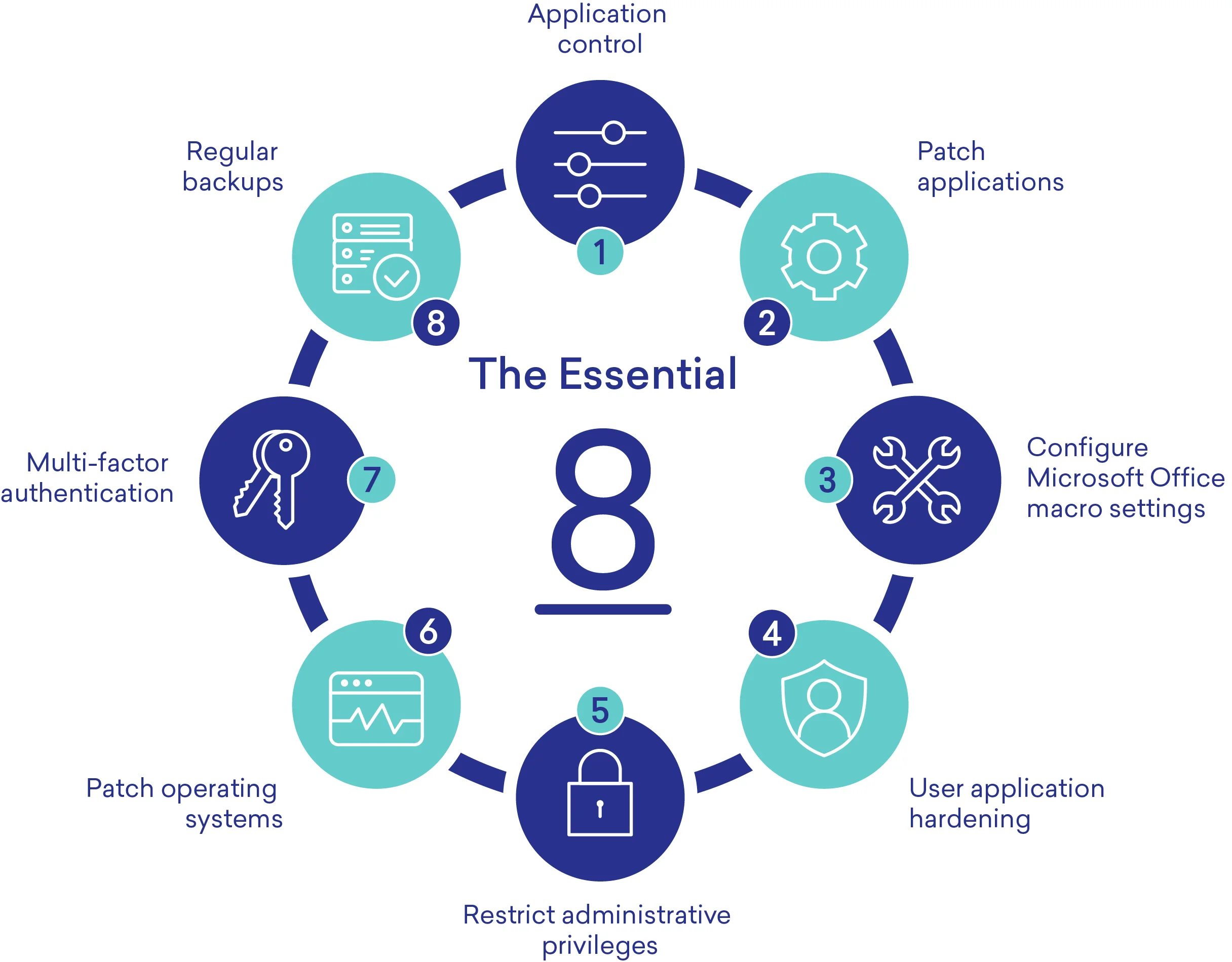
Essential 8 defines eight mitigation strategies to prevent cyber incidents: application control, patch applications, configure Microsoft Office macros, user application hardening, restrict admin privileges, patch operating systems, multi-factor authentication, and regular backups. It’s prescriptive, Australia-specific, and aligned with government and insurance expectations.
NIST Cybersecurity Framework organizes security activities into five functions: Identify, Protect, Detect, Respond, and Recover. It’s outcome-focused, allowing organizations to tailor implementation to their risk profile. Widely used internationally, particularly by US-based organizations and their suppliers.
ISO 27001 is an international standard requiring organizations to establish, implement, maintain, and continually improve an Information Security Management System (ISMS). Certification involves third-party audits and provides formal recognition of security practices.
Framework Comparison
| Aspect | Essential 8 | NIST CSF | ISO 27001 |
|---|---|---|---|
| Purpose | Baseline security controls | Risk management framework | Certified ISMS |
| Australian focus | Yes (ACSC framework) | No (US-based) | No (international) |
| Certification | No formal certification | No formal certification | Third-party audited certification |
| Prescriptive vs. flexible | Prescriptive (8 specific controls) | Flexible (outcome-based) | Flexible (process-driven) |
| Implementation time | 3-6 months (Maturity Level 1) | 6-12 months | 12-18 months |
| Cost (SMB) | $5,000-$15,000 (assessment) | $20,000-$50,000 (implementation) | $30,000-$80,000 (certification) |
| Ongoing effort | Annual reassessment | Continuous improvement | Annual surveillance audits |
| Insurance impact | Often required or incentivized | Recognized but not mandated | May reduce premiums |
| Government requirements | Required for gov contractors | Not required in Australia | Some tenders require it |
Which Framework to Implement First
Choose Essential 8 if:
- You’re an Australian SMB seeking baseline security (most common scenario)
- Cyber insurance requires it or offers premium discounts for compliance
- You work with government agencies or contractors (Essential 8 often mandatory)
- You want practical, prescriptive guidance on what to implement
- Budget is limited ($5,000-$15,000 for assessment vs. $30,000+ for ISO 27001)
Choose NIST CSF if:
- You’re a US subsidiary or have US parent company requirements
- You supply services to US-based customers expecting NIST alignment
- You want a risk-based approach rather than prescriptive controls
- You need a framework that maps to multiple compliance requirements
Choose ISO 27001 if:
- You need formal certification for customer assurance (B2B, enterprise sales)
- You operate in regulated industries (finance, healthcare, government)
- International customers require ISO 27001 in RFPs or contracts
- You can commit to annual audits and continuous ISMS maintenance
Recommended path for most Australian SMBs: Start with Essential 8 Maturity Level 1, then consider ISO 27001 if certification becomes a sales requirement.
Essential 8 and ISO 27001 Overlap
Implementing Essential 8 first provides a strong foundation for ISO 27001. Many Essential 8 controls directly map to ISO 27001 Annex A requirements (access control, patching, authentication, backups). Organizations that achieve Essential 8 Maturity Level 2 have addressed approximately 30% of ISO 27001’s technical controls, reducing certification effort.
Key Takeaways
- Essential 8 is the starting point for most Australian SMBs—it’s prescriptive, Australia-focused, aligned with insurance/government expectations, and costs $5,000-$15,000 for assessment.
- ISO 27001 is for businesses needing certification—enterprise customers, regulated industries, and international sales often require it; expect 12-18 months and $35,000-$80,000 first-year costs.
- NIST CSF suits organizations with US ties—subsidiaries, suppliers to US companies, or those needing flexible risk-based frameworks over prescriptive controls.
- Implement Essential 8 first, then pursue ISO 27001 if needed—Essential 8 provides technical foundation that maps to ~30% of ISO 27001 requirements.
Need help assessing which framework suits your business? Contact Eviant for Essential 8 assessments and ISO 27001 implementation guidance.
Related Resources
Essential 8 Compliance Guide for Australian Businesses: What You Need to Know
Eviant assesses your organisation against the Essential Eight through a structured, evidence-based maturity review with a transparent, fixed-price model. Engagements start at $5,000, delivering one of the lowest assessment price points in Australia.

Cyber Insurance Requirements in Australia: Security Controls Checklist
Australian cyber insurers increasingly require Essential 8 compliance and specific security controls before coverage. Learn what insurers expect, how to prepare for questionnaires, and cost factors.

Australian Privacy Act: Data Breach Notification Requirements
Australian businesses must notify the OAIC and affected individuals within 30 days if a data breach causes serious harm. Learn what triggers notification, assessment requirements, and disclosure obligations.
Ready to Work Together?
Let's discuss how we can help protect your business and achieve your security goals.