Essential 8 Compliance Guide for Australian Businesses: What You Need to Know
What is the Essential 8?
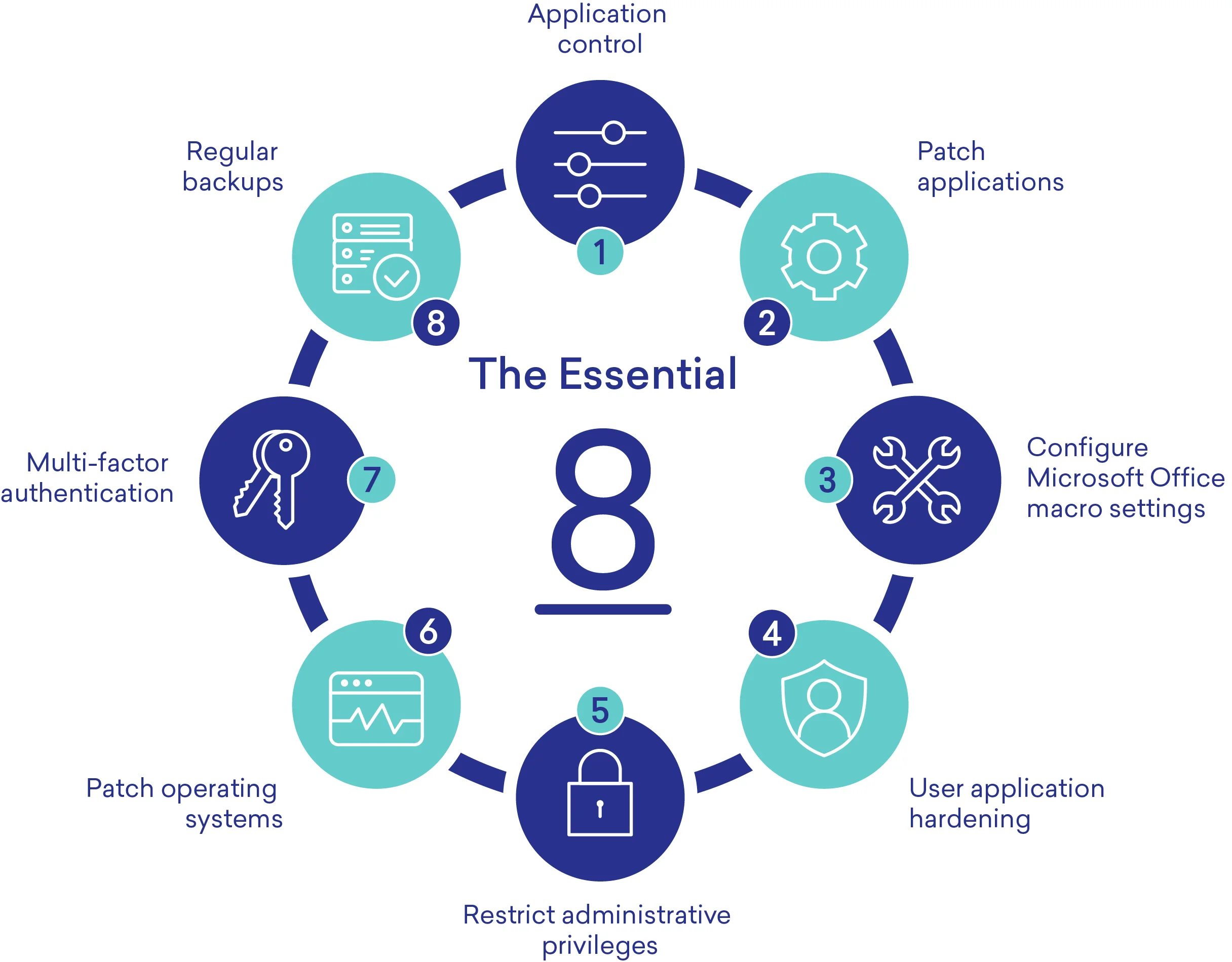
The Essential Eight (also known as the ASD Essential 8 or Essential 8 Maturity Model) is a cybersecurity framework developed by the Australian Cyber Security Centre (ACSC). It provides Australian businesses and organisations with a baseline set of strategies to protect against cyber threats and strengthen their security posture. Unlike complex compliance frameworks that require extensive documentation and resources, the Essential 8 focuses on practical, high-impact security controls that prevent the majority of cyber attacks targeting Australian organisations.
Why the Essential 8 Matters for Your Business
The Essential Eight isn’t just a government recommendation—it’s become the de facto cybersecurity standard for Australian businesses. Here’s why it matters:
- Effective: These 8 strategies mitigate up to 85% of targeted cyber intrusions
- Insurance requirements: Cyber insurance providers now require Essential 8 compliance
- Government contracts: Required for businesses working with government agencies
- Industry best practice: Austrlaian partners expect Essential 8 alignment
- Executive visibility: Provides clear, measurable security outcomes for leadership
Most importantly, implementing the Essential 8 significantly reduces your risk of ransomware, business email compromise, and data breaches—the most common threats facing Australian SMEs today.
The 8 Essential Strategies Explained
1. Application Control
What it is: Prevent unauthorized applications from executing on your systems
Why it matters: Malware can’t run if it’s not on the approved list of programs your business approves. This strategy is effective but can at times be in-practical for businesses.
Business impact: Requires balancing security with user productivity. We help implement application control that works for your business operations.
2. Patch Applications
What it is: Keep all applications up-to-date with the latest security patches.
Why it matters: Attackers actively exploit known vulnerabilities in popular applications like Adobe Reader, web browsers, and Microsoft Office.
Business impact: Missing patches are one of the top entry points for cyber criminals. Regular patching must be balanced with testing to avoid disrupting business operations.
3. Configure Microsoft Office Macro Settings
What it is: Block macros from the internet and only allow vetted macros from trusted locations.
Why it matters: Malicious macros in documents (especially Excel and Word files) are a primary delivery method for malware in email attacks.
Business impact: Most businesses don’t need macros. For those that do, we help identify legitimate business needs and implement secure alternatives.
4. User Application Hardening
What it is: Configure applications to block risky features like Flash, ads, and Java in web browsers.
Why it matters: Web browsers are a common attack vector. Hardening reduces the risk from malicious websites and drive-by downloads.
Business impact: Improves security without impacting day-to-day operations for most users.
5. Restrict Administrative Privileges
What it is: Limit who has admin rights and use separate accounts for admin tasks.
Why it matters: Most successful cyber attacks require admin privileges to spread or cause significant damage. Restricting admin access limits the blast radius of an incident.
Business impact: This often requires workflow changes but is one of the most effective controls. We help implement practical privilege management that doesn’t hinder productivity.
6. Patch Operating Systems
What it is: Keep Windows, macOS, Linux, and mobile operating systems updated with the latest security patches.
Why it matters: Operating system vulnerabilities are actively exploited. The 2017 WannaCry ransomware attack exploited an unpatched Windows vulnerability.
Business impact: Like application patching, this requires a balance between security and operational stability.
7. Multi-Factor Authentication (MFA)
What it is: Require an additional verification step beyond passwords (e.g., SMS code, authenticator app, biometric).
Why it matters: Compromised passwords are involved in over 80% of breaches. MFA stops attackers even if they have your password.
Business impact: Essential for remote access, cloud services (Microsoft 365, AWS, Azure), and admin accounts. Modern MFA solutions are user-friendly and don’t significantly impact productivity.
8. Regular Backups
What it is: Maintain regular backups of important data and test your ability to restore from them.
Why it matters: Backups are your last line of defense against ransomware. If you can restore from backups, you don’t have to pay the ransom.
Business impact: The difference between a minor incident and a business-ending disaster. We help implement the 3-2-1 backup rule: 3 copies, 2 different media types, 1 offsite.
Essential 8 Maturity Levels
The ACSC defines three maturity levels for Essential 8 implementation:
Maturity Level One: Partly aligned with intent. Minimum viable security posture.
Maturity Level Two: Mostly aligned with intent. Good security practices for most organisations.
Maturity Level Three: Fully aligned with intent. Highest level of protection for high-risk organisations.
Most Australian SMEs should target Maturity Level Two as it provides strong security without excessive overhead. Government agencies and critical infrastructure typically require Maturity Level Three.
Common Implementation Challenges
1. Limited IT Resources
Many SMEs don’t have dedicated IT security staff. The Essential 8 requires ongoing maintenance, not just one-time setup.
Our approach: We provide guidance on prioritising controls and can supplement your team with support when needed.
2. User Resistance
Security controls like restricted admin privileges and application control can feel restrictive to users.
Our approach: We work with your team to implement controls that balance security with usability, and provide user education to build security awareness.
3. Legacy Systems
Older systems and applications may not support modern security controls like MFA or patching.
Our approach: We help assess legacy system risks and develop compensating controls or migration plans.
4. Budget Constraints
Implementing all 8 strategies can require investment in tools, training, and potentially new infrastructure.
Our approach: We help prioritise based on your risk profile and phased implementation to spread costs over time.
How Eviant Can Help with Essential 8 Compliance
At Eviant, we take a business-first approach to Essential 8 implementation:
-
Gap Assessment: We assess your current security posture against the Essential 8 framework and identify gaps.
-
Practical Roadmap: We create a prioritised implementation plan that aligns with your business operations and risk tolerance.
-
Implementation Support: We can implement controls for you, guide your IT team, or work collaboratively—whatever fits your needs.
-
Ongoing Compliance: Essential 8 isn’t set-and-forget. We provide ongoing support to maintain compliance as your business and the threat landscape evolve.
-
Evidence Collection: We help document your compliance for audits, insurance requirements, or government contracts.
Essential 8 Checklist: Getting Started
Ready to start your Essential 8 journey? Here’s what to do first:
- Understand your current state: Document what security controls you currently have in place
- Identify critical systems: Map your most important systems and data
- Review your risk profile: What threats are most relevant to your industry?
- Prioritise quick wins: Some controls like MFA can be implemented quickly
- Plan for user impact: Communicate changes and provide training
- Set realistic timelines: Essential 8 implementation typically takes 6-12 months
- Get expert help: Consider engaging a cybersecurity consultant to accelerate implementation
Conclusion
The Essential 8 provides a practical, proven framework for Australian businesses to strengthen their cybersecurity posture. While implementation requires investment and effort, the risk reduction and business benefits far outweigh the costs—especially when compared to the average cost of a cyber incident. Don’t wait for a breach to take cybersecurity seriously. The Essential 8 gives you a clear roadmap to mitigate cyber risk.
Need Help with Essential 8 Compliance?
Eviant helps Australian businesses implement the Essential 8 framework in a practical, way without impacting your business operations.
Get in touch: security@eviant.com.au
Learn more: Essential 8 Services
Related Resources

Cyber Insurance Requirements in Australia: Security Controls Checklist
Australian cyber insurers increasingly require Essential 8 compliance and specific security controls before coverage. Learn what insurers expect, how to prepare for questionnaires, and cost factors.

Australian Privacy Act: Data Breach Notification Requirements
Australian businesses must notify the OAIC and affected individuals within 30 days if a data breach causes serious harm. Learn what triggers notification, assessment requirements, and disclosure obligations.

Information Security Policies: Why They Matter and How to Get Started
Information security policies define how your business protects data, manages risk, and responds to incidents. Learn why policies matter, what the essential ones are, and where to find templates.
Essential 8 Assessment
Eviant assesses your organisation against the Essential Eight through a structured, evidence-based maturity review with a transparent, fixed-price model. Engagements start at $5,000, delivering one of the lowest assessment price points in Australia.