
Agentic DFIR: Harness Engineering for Full Incident Investigations
On this page
- Abstract
- 1. Introduction
- 2. Agentic attacks need agentic investigation
- 3. Method
- 3.1 Questions and evidence
- 3.2 Processing
- 3.3 Supporting human investigators
- 3.4 The lead and its helpers
- 3.5 The loop and the coverage gate
- 3.6 Steering and review
- 3.7 Integrity, audit and reproducibility
- 4. Szechuan Sauce: setup
- 5. Szechuan Sauce: results
- The generated report
- 6. Comparison on the NIST Data Leakage case
- 7. Discussion
- 8. Limitations
- 9. Conclusion
- Where we are taking this
- References
Abstract
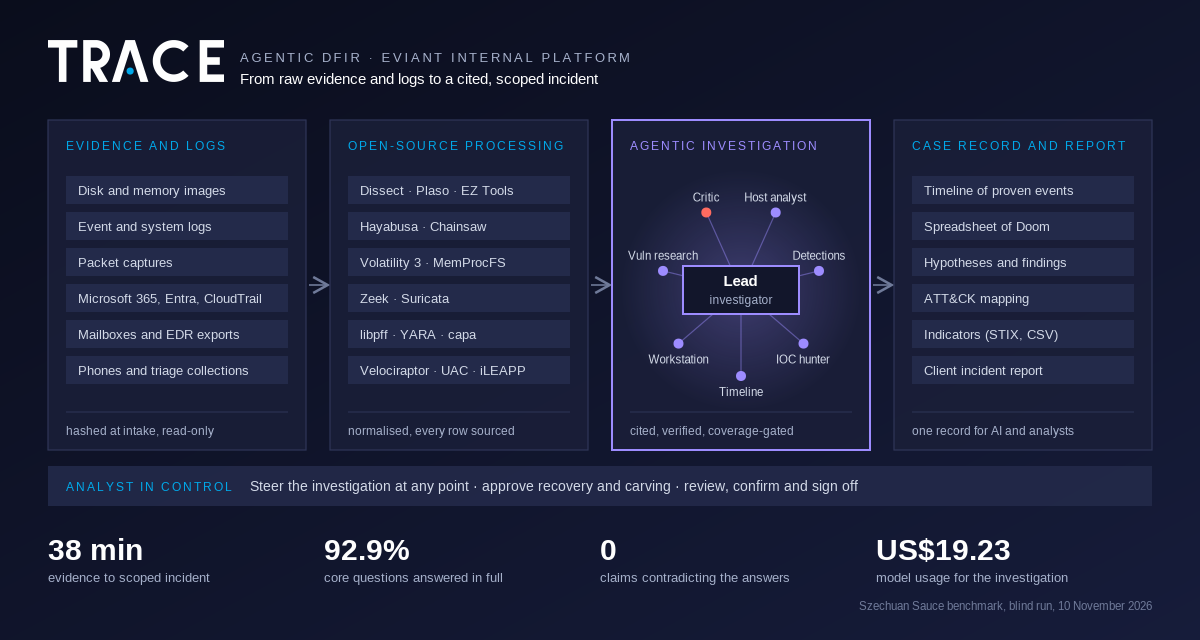
Threat actors are now operationalising multi-agent AI frameworks that carry out reconnaissance, exploitation and lateral movement against many organisations at once. Defensive AI has focused on alert triage, and AI-led investigation of a complete intrusion remains immature. Eviant TRACE, our incident response and threat research team, built an internal platform in which a lead AI investigator directs specialist agents through a case end to end, using open-source forensic tools, independently verified citations and a coverage gate that decides when the work is complete.
We evaluated it on two public cases. On DFIR Madness’s “The Stolen Szechuan Sauce”, a blind, unassisted run answered 13 of 14 core questions in full and detected all 14, with no claim contradicting the published answers, in 38 minutes for US$19.23. On the NIST CFReDS Data Leakage case, scored on the 20 items used by Mulder, the open-source DFIR agent that won the SANS Find Evil Hackathon 2026, it answered 60–65% in full against Mulder’s 45–50%, and detected 85% and 95% across two runs. These results are preliminary; Section 8 sets out their limits.
1. Introduction
In October 2026 CrowdStrike reported that a threat actor it tracks as Vapor Panda had used ARTEX, an open-source multi-agent penetration-testing framework, against more than 200 organisations in 14 countries (BleepingComputer). Planner agents broke goals into tasks. Worker agents ran reconnaissance, exploited vulnerabilities, dropped web shells, harvested credentials and switched attack paths when blocked, while human operators steered several intrusions at once and stepped in only at key decisions. One target, the Dutch Institute for Vulnerability Disclosure, logged more than 450,000 requests and 2,500 scripts in a single intrusion that went from initial access to root in 12 minutes. Censys later counted 1,465 hosts exposing an ARTEX console to the internet (report).
The campaign shows an escalation “from single intrusions to multiple simultaneous engagements directed by a human operator.” (CrowdStrike, as reported by BleepingComputer)
Legitimate offensive security got there first. PentAGI, an MIT-licensed autonomous pentesting system, runs specialised agents under an orchestrator, executes more than 20 tools such as Nmap, Metasploit and sqlmap in isolated Docker containers, and keeps long-term memory in PostgreSQL with pgvector. When one operator can run a dozen intrusions in parallel, more incidents need a real investigation and each leaves more noise behind.
2. Agentic attacks need agentic investigation
A real investigation is slow for good reasons. Every system has to be acquired and processed, a timeline built across disk, memory, logs and network, competing explanations tested, and conclusions written that hold up before a board, an insurer or a court. Even a two-host intrusion typically takes days of senior analyst time, much of it spent running parsers, reading output and cross-referencing hashes and timestamps. Attackers who run agents can open more intrusions, faster, than any team can work through at that pace, and they won’t wait for the industry to train more investigators. Investigation has to become agentic too.
Most of the industry’s AI effort has gone into the SOC (we covered why in Your SOC Can’t Keep Up), and triage is a different problem.
| AI SOC: alert triage | AI investigator: full DFIR case | |
|---|---|---|
| Scope | One alert at a time | Whole systems: disk and memory images, logs, packet captures, cloud tenants, mailboxes, phones |
| Data | Minutes of telemetry already in the SIEM | Millions of parsed records over weeks or months |
| Output | Escalate or close | What happened, when, how, to what, by whom, and what remains unknown |
| Cost of a mistake | An extra ticket | A wrong client report, insurance claim or court submission |
Ask a general-purpose agent to investigate a disk image and it will run a few tools, read a sample of the output and write a confident story. Nothing in its setup stops it skipping sources it never opened, misquoting timestamps or failing to show where a claim came from. We started from the hypothesis that the model is rarely what limits this work. The harness usually is.
3. Method
We built the harness from patterns that open agent frameworks have proven, plus the controls an evidential discipline needs. It covers everything around the model: what it can see, which tools it may call, where its work is stored, what it must prove before a claim counts, and when it has to stop and ask.
| Source | What we took, or added |
|---|---|
| PentAGI and similar frameworks | An orchestrator with specialists working in parallel; every tool in a pinned, isolated container; memory in a database outside the model’s context window, so long cases survive context summarisation |
| Open DFIR agents such as Mulder (section 6) | Typed tools instead of a raw shell on the server; findings that cite real tool output; hashed, read-only evidence; adversarial review before conclusions; publishing accuracy against public cases with answer keys |
| Our additions | The server re-reads every quoted citation value; a coverage gate computed from the platform’s own query logs; “corroborated” requires two independent source families, enforced in server code; analysts hold every conclusive or risky decision |
3.1 Questions and evidence
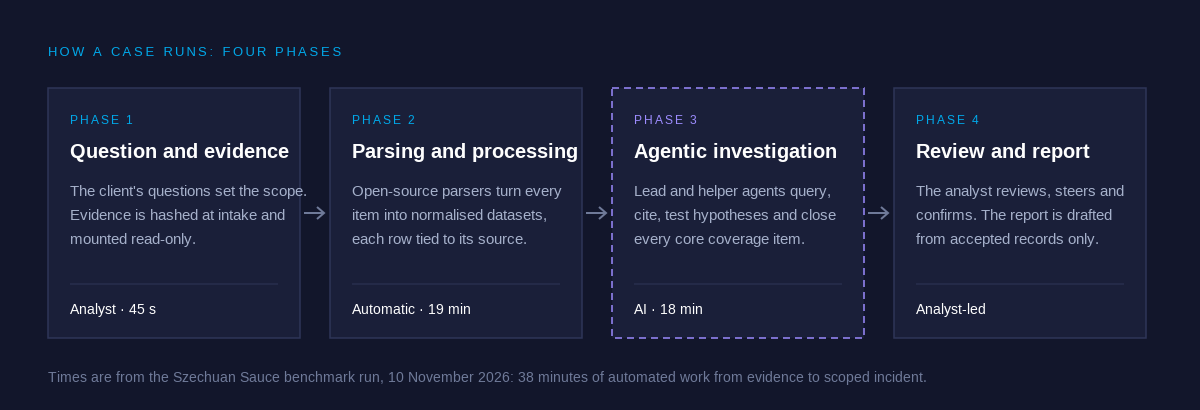
The client’s questions (was there a breach and how did they get in, was data taken, is this employee responsible) set the scope and the investigator’s first plan, and the report has to answer them. The investigator cannot declare the work done while one has no recorded answer.
Evidence can be Windows and Linux disk images (E01, raw, split sets) and memory images; Velociraptor, UAC (Linux and macOS) and KAPE-style triage collections; Windows event logs and any other timestamped text, JSON or CSV log; PCAP and PCAPNG captures; Microsoft 365 and Entra ID audit and sign-in logs and AWS CloudTrail; EDR exports; PST, OST, EML and MBOX mailboxes; and iOS, Android, AndroidQF and macOS acquisitions. Each item is hashed at intake with MD5, SHA-1 and SHA-256, compared with the acquirer’s hash where one is supplied, and locked read-only. Evidence is never executed. Malware triage is static only, and there is no detonation sandbox.
3.2 Processing
The investigator doesn’t parse raw evidence. A recipe per evidence type runs established open-source tools, each in a pinned container with no network access, and normalises their output into datasets the agent queries with SQL. Every record keeps its source file and location (line, record or file-system entry) so it can be cited. Parsing once and querying many times is what lets the agent ask hundreds of questions in minutes.
| Evidence | Tools |
|---|---|
| File systems and Windows artefacts (registry, MFT and USN journal, LNK, jump lists, shellbags, prefetch, Amcache) | Dissect, Plaso, Eric Zimmerman’s tools |
| Windows event logs, with Sigma rules | Hayabusa, Chainsaw |
| Memory | Volatility 3, MemProcFS |
| Packet captures | Zeek, Suricata |
| Mailboxes; static triage of executables found on disk | libpff; YARA, capa, FLOSS |
| Triage collections and phone extractions | Velociraptor, UAC, iLEAPP, ALEAPP |
| Microsoft 365, Entra ID and CloudTrail | Microsoft Extractor Suite, Suzaku |
| Deleted-file recovery and carving (opt-in, approved by an analyst) | bulk_extractor, PhotoRec, The Sleuth Kit |
None of this needs a commercial licence. Two optional components are not open source, and the investigator works without either. Nextron’s THOR Lite scanner is free but closed source and runs only where its licence file is installed; it did not run in the Szechuan run or the first NIST run, because its reference files were absent and those steps exited “not installed”. The per-case Splunk below is Splunk Enterprise on its free licence, limited to 500 MB of ingest a day.
3.3 Supporting human investigators
Every processed and normalised artefact is available to analysts in a local SQL store, the same data the AI queries, so an analyst who wants to dig further starts from the parsed case, not from raw images. The datasets can also be ingested into Elastic or Splunk, licensed as appropriate, for teams that prefer to search there. A SANS SIFT forensic desktop can be deployed on demand in the browser, with the raw evidence mounted read-only, for an analyst to work by hand or for the lead investigator to use through a guarded, audited command tool.
3.4 The lead and its helpers
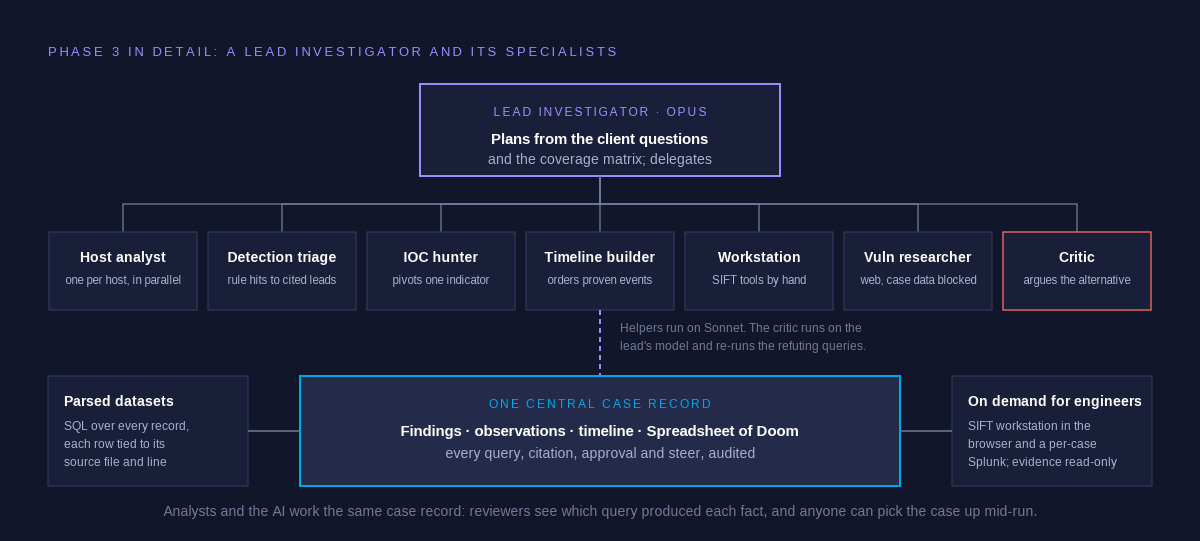
After processing, a lead investigator on Claude Opus 5.5 plans from the client’s questions and the coverage matrix and hands self-contained work to helpers on Claude Sonnet 5.5, launching independent ones together so they run in parallel. Each helper has a narrow brief and its own tool allowlist, writes straight into the central case record that the lead, the other helpers and the analyst all see, and reports back tagged with the client questions and record ids it bears on.
| Helper | Detail |
|---|---|
| host-analyst | One per host: execution, persistence, logons and file activity; works the host’s open coverage items, records its identity and time zone, adds timeline events and Spreadsheet of Doom rows, and documents report-worthy artefacts verbatim |
| detection-triage | Finds the raw event behind each Hayabusa, Chainsaw or THOR hit and flags false positives |
| ioc-hunter | Pivots one IP, domain, hash, account or file name across every host and dataset, with first and last seen |
| timeline-builder | Orders proven events, checks clock skew, maps to ATT&CK, flags gaps |
| vuln-researcher | The only agent with web access, and it has no case tools; it researches a product and version from generic terms, and the harness blocks any query, fetch or brief that carries case data |
| critic | Runs on the lead’s model; argues the strongest benign or different-actor explanation, checks every cited row says what the hypothesis claims, re-runs the refuting queries and records a verdict |
The lead keeps the judgement. It proposes findings and moves them between states, answers the client’s questions from the helpers’ facts, and keeps the plan, the hypothesis matrix and the case summary coherent. A separate report team (a gatherer that builds a facts pack from accepted records, section writers, a diagram builder and an editor) drafts the report on request.
3.5 The loop and the coverage gate
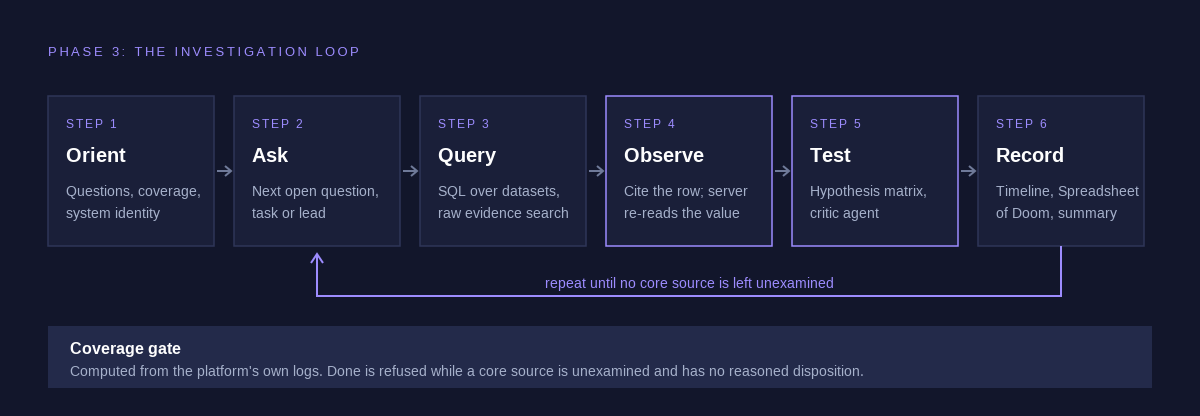
Observations state literally what a row or evidence line shows. The server re-reads each cited value from the logged query snapshot or the evidence file and rejects a misquote, returning the actual value. Inference goes in findings, which must link to observations. Before a finding is proposed as corroborated, the critic argues the alternative and re-runs the queries that would refute it.
When the lead declares the objective answered, the server checks the coverage matrix: the artefact sources each system’s profile expects, about forty for a Windows host, from the Security event log to shellbags. The matrix is computed from the platform’s own query, search and workstation logs, and the agent’s account of its own work plays no part in it. “Done” is refused while a core source is available and unexamined. An item closes only when it has been queried or given a reasoned disposition such as “not relevant” or “not present”, which is labelled as the AI’s and can be overridden by an analyst. Three refusals with no progress end the run, flagged “coverage incomplete”.
The case file stays current on every turn. Every timeline event carries a time that must equal a time its citation records. The Spreadsheet of Doom, the familiar incident response tracker, holds hosts, accounts, indicators, malware, exfiltration, containment and vulnerabilities. The hypothesis matrix, recorded gaps (missing evidence, stated as such) and an ATT&CK mapping sit alongside.
3.6 Steering and review
The analyst sets the agent’s autonomy and can change it mid-run without stopping it.
| Run mode | Behaviour |
|---|---|
| Autopilot | Starts processing, adds evidence and runs workstation commands on its own; data-recovery commands are still refused |
| Supervised | Reads and proposes freely; asks before processing, adding evidence or running a workstation command outside a read-only list |
| Ask first | Asks before every write and every tool run, for sensitive matters |
A case setting decides how much of the AI’s work applies without review, from everything waiting for an analyst to everything applying straight away, and some actions, such as marking evidence as reviewed, always wait for a person. Analysts can steer the investigation at any time: a message such as “look at the VPN logs before the 14th” or “the CFO’s laptop is out of scope” is picked up after the current step, a question or task becomes the next line of enquiry, and rejecting or editing one of the AI’s proposals tells it why and stops it from recreating it. The AI can suggest deleted-file recovery and carving but never run them without approval, and only an analyst can confirm a finding, approve client wording or produce the final report, which is drafted from accepted records only. The server rejects any drafted section that cites missing records or states facts the records do not support.
3.7 Integrity, audit and reproducibility
The platform is built so that any statement in a case can be traced back to the evidence and checked by someone else, and so that nothing the AI does can alter the evidence or the record of what happened.
| Area | How it works |
|---|---|
| Evidence integrity | Evidence is read-only on disk and in every mount, and writable mounts are refused. Items are hashed at intake and can be re-hashed at any time as chain-of-custody events. For E01 sets the segment files are hashed and the acquirer’s media hash is recorded |
| Traceability | Every AI query is logged with its purpose and a hashed snapshot of its results. Observations cite a query row or a file and line range, raw excerpts are quoted only after the file’s hash is checked against intake, and re-parsing a dataset flags its citations as stale |
| Audit log | Append-only and hash-chained, with edits and deletes refused by the database. The chain can be re-verified at any time, and each report records the point in the chain it was built from |
| Time | Stored in UTC and never rewritten. The investigator states each source’s time basis, each system’s configured time zone and any clock offset it measures |
| Reproducibility | Tool images are pinned by digest and unpinned images are refused. Jobs record tool versions and input and output hashes, and benchmark runs also record the platform commit, the answer key, the evidence hashes, the models and settings, and timings |
| AI boundaries | No shell or file access on the server, and a token scoped to one case. The AI cannot delete anything, approve its own work or a recovery request, close or export a case, or change its permissions, and text found in evidence is treated as data, never as instructions |
The model is not deterministic, so a re-run will not produce an identical case file, which is why each configuration needs repeated runs. Evidence, datasets and the case database stay on the platform host, but what the AI reads (query results, excerpts and command output) is sent to the Anthropic API as part of its conversation, which belongs in any engagement’s data-handling terms. Web research is a per-case switch that keeps case identifiers from leaving the platform, and it was off for the Szechuan run and the first NIST run.
4. Szechuan Sauce: setup
The Stolen Szechuan Sauce from DFIR Madness is a public training case of a small network intrusion: a Windows Server 2012 R2 domain controller and a Windows 10 desktop, disk and memory images of both, and a 7.7-hour packet capture.
We encoded the author’s published answers as 15 questions. The 14 core questions cover the operating systems, the breach and entry vector, the malware and its capabilities, delivery, location, persistence and C2, lateral movement, data theft, anti-forensics, the network layout and the malicious process. The fifteenth, the server’s time zone, is left out of the core set because the author notes that the virtual machines’ UTC offset was set incorrectly and the published answer is disputed. Each question has required facts with matching rules. Known-wrong statements that would count as false positives are encoded where the answers give one; this case has only one.
| Condition | Setting |
|---|---|
| Brief | Blind: a case id and the evidence, nothing about the scenario; the investigator never saw the answer key |
| Mode | Autopilot, no budget cap, case set to Autonomous (no review during the run) |
| Human input | None from start to finish: no message, approval or answer |
| Switched off | Web research, threat-intel lookups, carving |
| Operator intervention | The job controller refused the workstation’s container image as unpinned and the operator re-pinned it; the investigator was not told or steered |
| Hardware | One mini PC (Ryzen 7640HS), 26 GB of RAM for the virtual machine |
| Scoring | A deterministic scorer graded each question found, partial or missed from the exported case. Lenient counts every live finding, observation, timeline event, Spreadsheet of Doom row and summary. Strict counts only findings moved to corroborated, which the server allows only with two independent source families |
5. Szechuan Sauce: results
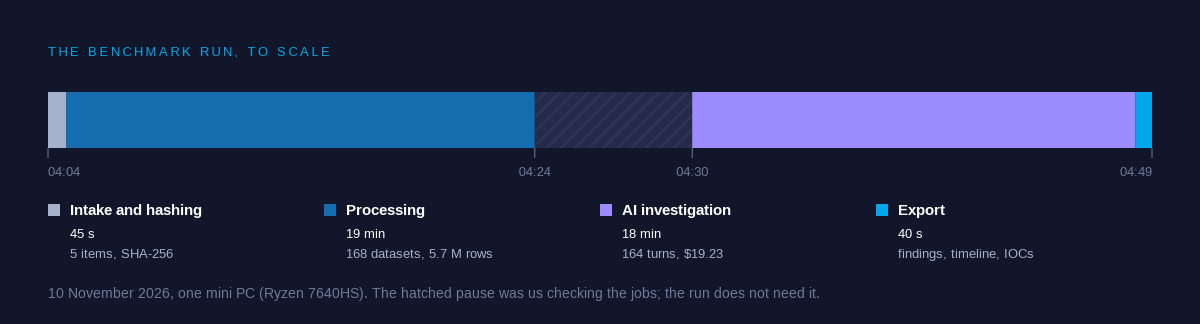
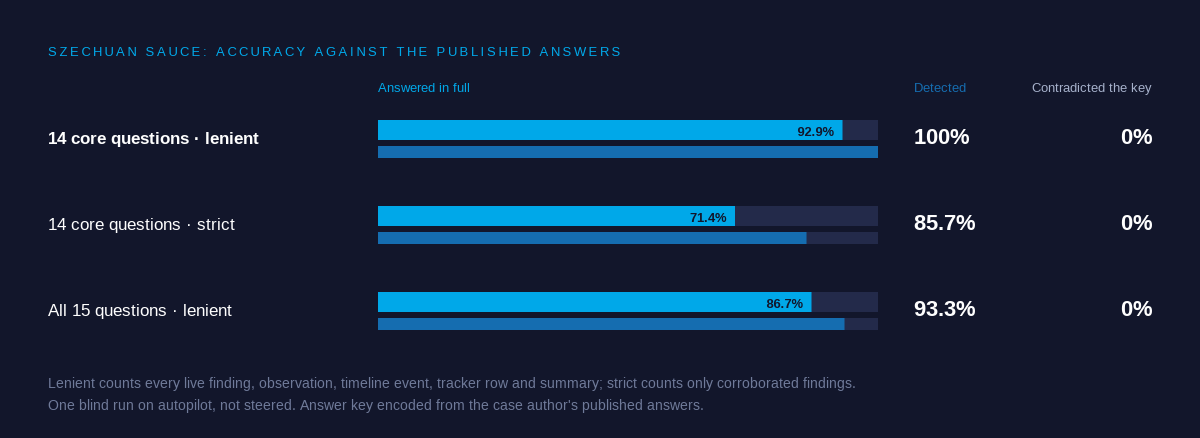
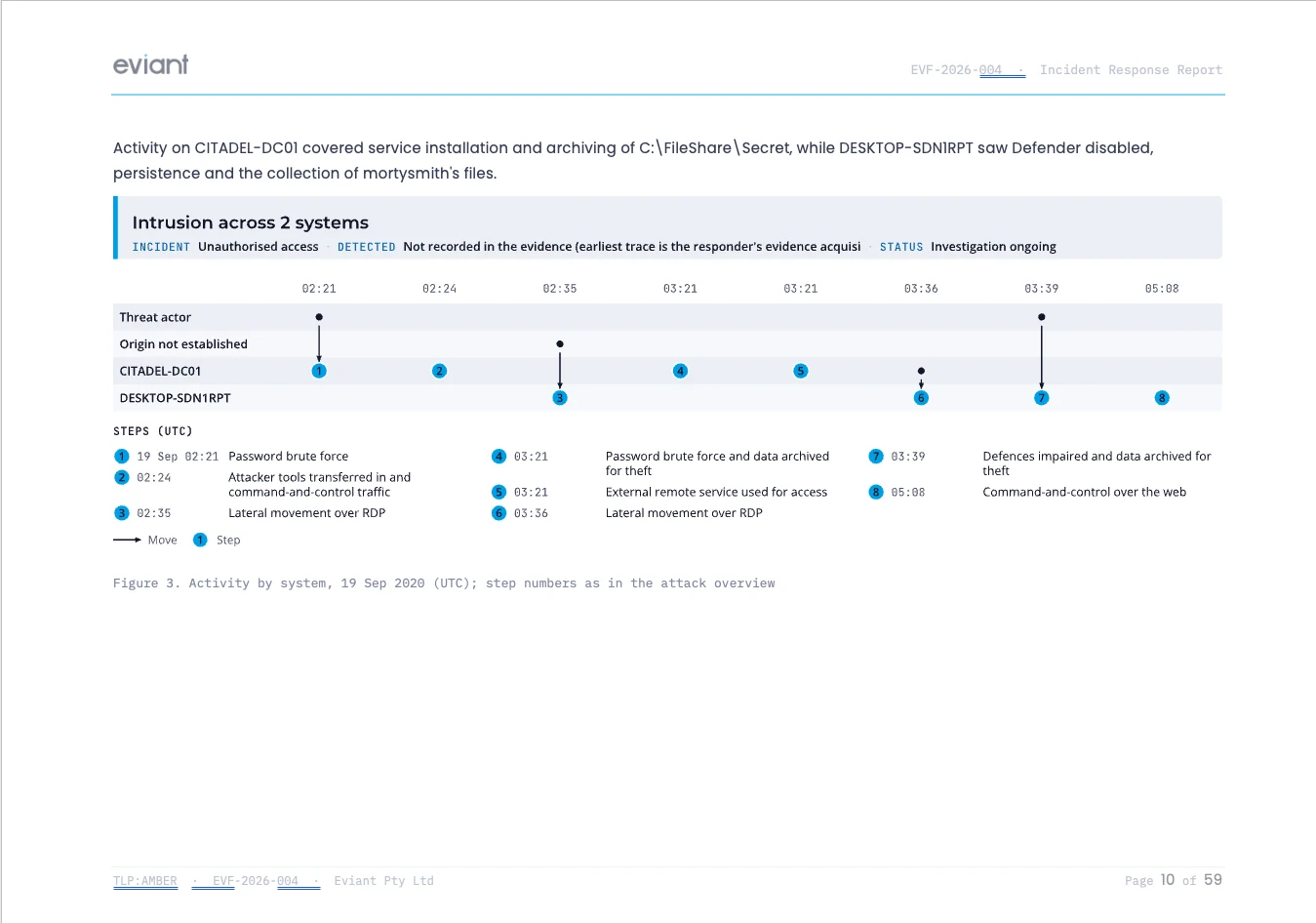
The investigator reconstructed the chain: an RDP brute force from 194.61.24.102 against the domain controller; coreupdater.exe downloaded with Internet Explorer, moved into System32 and installed as a service; Meterpreter components injected into spoolsv.exe and connections to 203.78.103.109; RDP from the domain controller to the desktop; files opened in the file share, Secret.zip created and deleted, and an archive on the desktop renamed loot.zip; and a time-stomped Beth_Secret.txt. It finished with seven corroborated findings, each challenged by the critic.
Seven further claims went beyond the key. Among them were a second, fileless persistence (a Run key launching a PowerShell loader held in the registry), the named-pipe services Meterpreter uses to obtain SYSTEM, and the responder’s own FTK Imager session, which the investigator kept apart from the attacker’s activity. We read those seven against the case write-up without re-checking them in the evidence, and judged none wrong. The investigator also recorded what it could not answer. It did not establish that the archives left the network (the author says they did; the scorer doesn’t test it), and it could not recover the attacker’s command lines on the server.
The packet capture records events exactly one hour earlier than the host logs. The investigator checked the offset at three separate points, called it a clock difference, and stated that its times use the host-log clock. The author’s answers use the capture-aligned times, so every host-log time in the run is an hour later than the author’s. The run did not determine which clock was right.
Both imperfect answers are about time. The recipe file’s theft was found but scored partial because the scorer matched no time for it: the run gave the window in which the share’s files were opened, on the host-log clock, an hour after the author’s time. The one miss was the server’s configured time zone, which was never stated. Each system’s identity and configured time zone is now a core coverage item that blocks “done” until its source has been examined, and the method requires one time-zone observation per system. No run has tested that change yet.
Strict scores are lower mainly because some correct answers, the operating systems among them, were recorded as observations and never became corroborated findings. Strict measures what the agent was willing to stand behind; lenient measures what it found.
The generated report
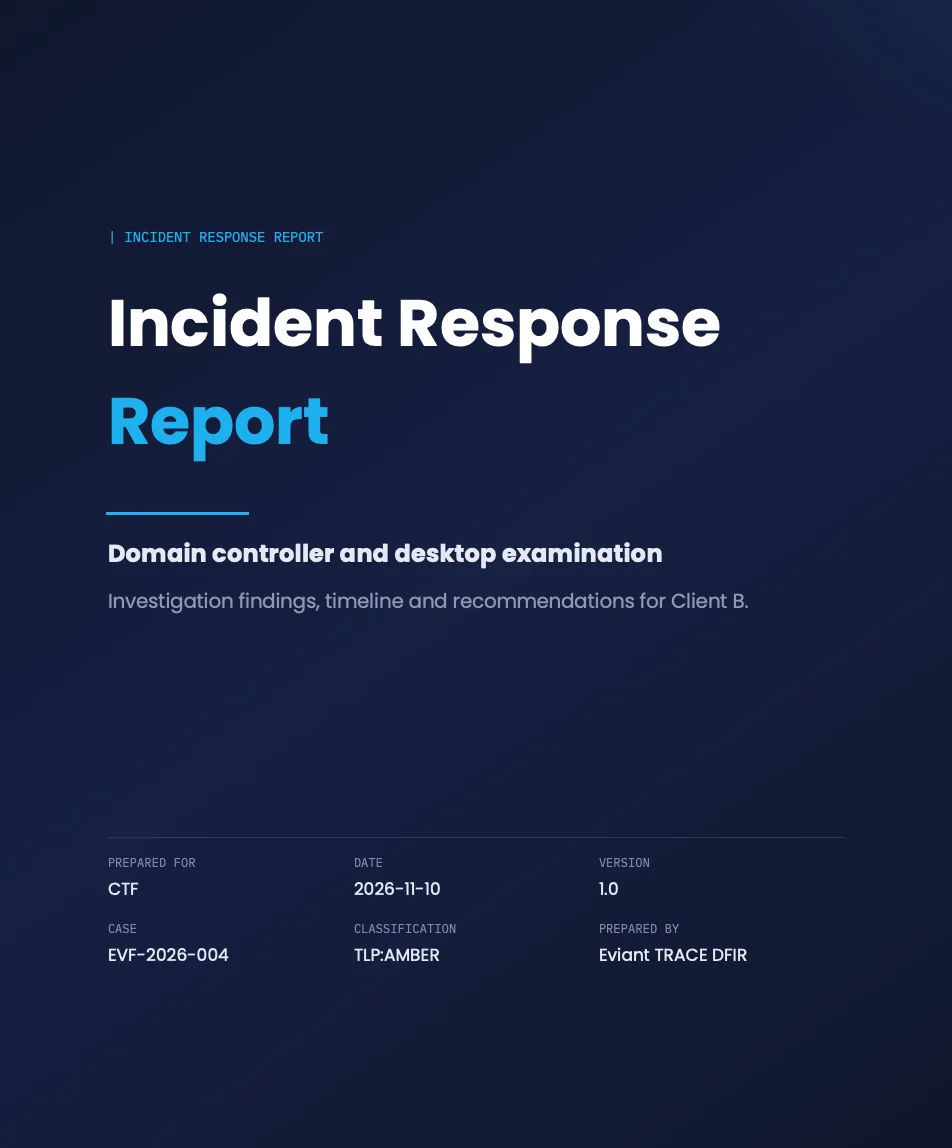
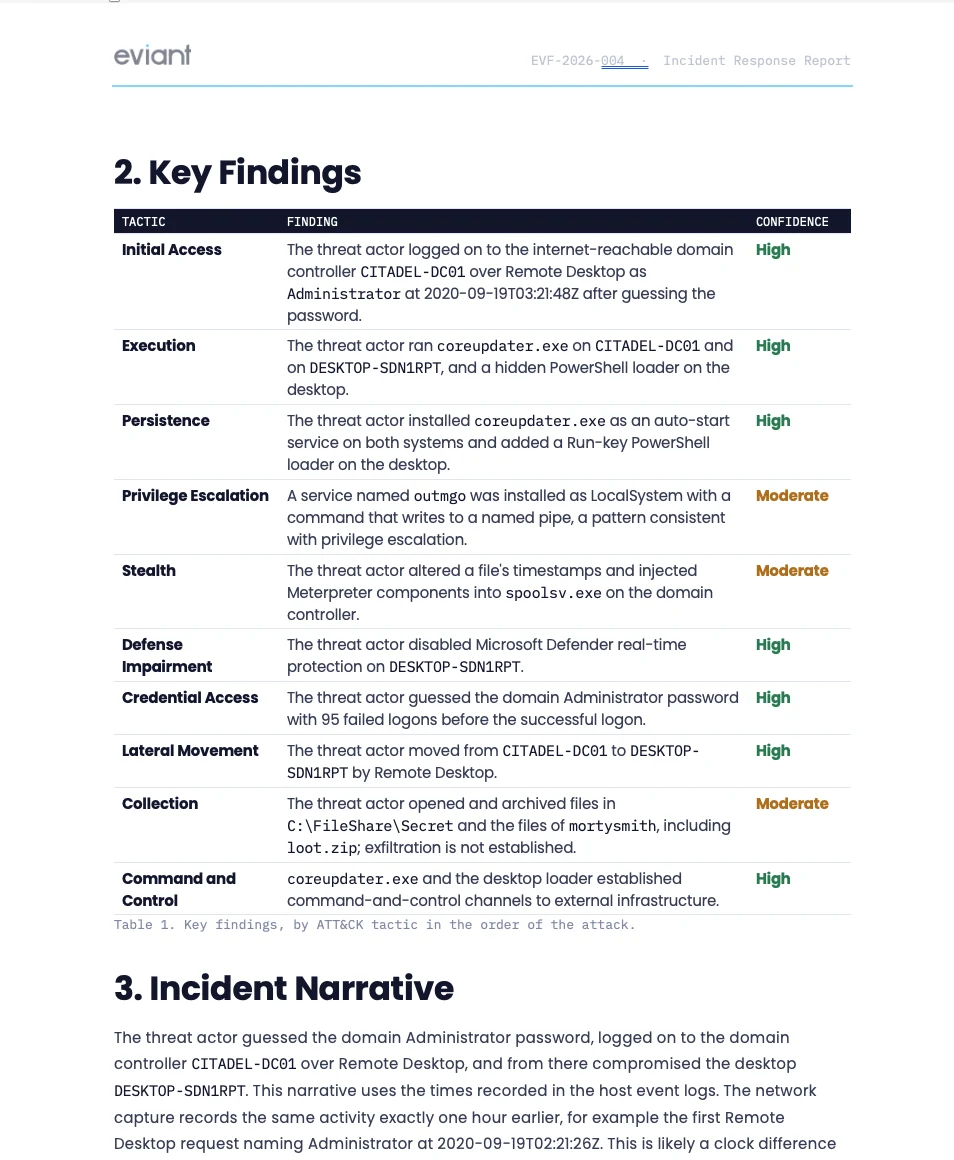
After the scored run the platform generated the full report for the case from its records. It runs to 59 pages. It was not part of the score, and no analyst reviewed it before these screenshots were taken.
6. Comparison on the NIST Data Leakage case
The Szechuan case has no published results from other agents, so we needed a second case to compare against. The NIST CFReDS Data Leakage Case is a reference scenario that the US National Institute of Standards and Technology publishes in its Computer Forensic Reference Data Sets. An employee leaks confidential project documents through USB drives, an optical disc and cloud storage, then tries to cover their tracks. The evidence is a Windows 7 PC image and images of three removable media, and NIST publishes a detailed answer document.
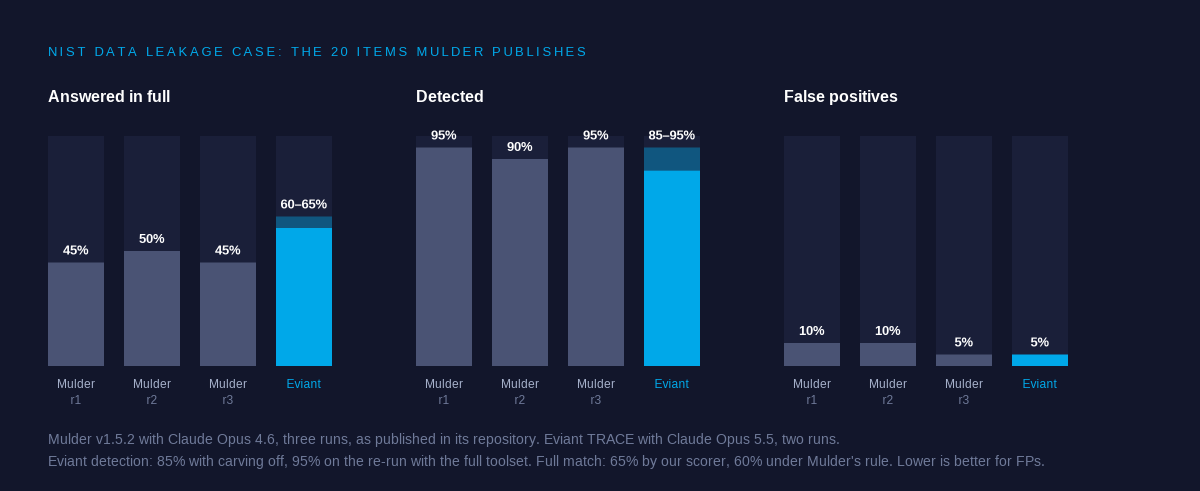
Mulder is an Apache-2.0 open-source DFIR agent that won first place in the SANS Institute Find Evil Hackathon 2026. It is good work, and we learned from it. It runs a five-phase investigation from the command line over 140-plus typed tool operations, and its authors publish every report and a hand-scored, item-by-item accuracy report on the NIST case against 20 answer-key items, three runs per model, which made it the most directly comparable published result we found. We scored ours on the same 20 items with Mulder’s definitions (full match, detection, false positives against the answer key), with a mechanical scorer where Mulder’s authors scored by hand.
| Run | Answered in full | Detected | False positives |
|---|---|---|---|
| Mulder v1.5.2, Claude Opus 4.6 (three published runs) | 45–50% | 90–95% | 5–10% |
| Mulder pre-release, Claude Opus 4.6 (one published run) | 65% | 95% | 5% |
| Mulder v1.5.1 baseline (one published run) | 60% | 90% | 5% |
| Eviant TRACE, Claude Opus 5.5 (two runs: 85% with carving off, 95% with the full toolset) | 60–65% | 85–95% | 5% |
We answered more items in full than any of Mulder’s three v1.5.2 runs and matched its best detection on the re-run, with one false positive on the CCleaner item that Mulder’s reports also record in every Opus run. The first run’s investigation took 36 minutes and cost US$27.49, against Mulder’s reported 68 to 79 minutes per run.
The bigger difference is in how the two are built. Mulder is a strong single-investigator command-line tool that runs unattended. Our platform is built for a team, with everything about a case held in one place.
| Mulder | Eviant TRACE platform | |
|---|---|---|
| Where the work lives | Local per-case database and log on the machine running it | One central case database with a hash-chained audit log |
| People and control | One operator; runs unattended once started | Multiple analysts and reviewers who can steer, approve and review at any point |
| Citations | Must reference a real tool call | Quoted values are re-checked by the server against the evidence |
| Coverage | Coverage audits before the report | The case cannot close while a core source is unexamined |
| Recovery and carving | Available to the agent | Run only after an analyst approves |
Keeping the work in one place means a reviewer can see which query produced each fact and a second analyst can pick up the case mid-run.
7. Discussion
What changes is where an investigator’s hours go. The mechanical first pass (processing, the first timeline, the obvious indicators, the cross-checks) is done before an analyst opens the case, so the same team can take on more matters and surge capacity for a major incident depends less on who is free that week. On a small lab case a cited first-pass case file arrived in under an hour. If that holds on real incidents, early containment decisions can rest on evidence instead of assumptions made while waiting for processing.
Every case is held to the same coverage checklist, so a source an experienced analyst would check is checked, or its omission is recorded with a reason. With every quote verified by the server, review becomes checking interpretations and citations without redoing the work, though the interpretation still needs a human. Playbooks, house style and lessons from reviews are written into the harness once and apply on every case, which also gives junior analysts a worked case file to learn from. The first investigations on the two benchmarks used $19 and $27 of model usage at API rates, excluding hardware and analyst review time, which puts an AI first pass within reach of matters that would never have justified days of senior time.
The Szechuan run used the least supervised setting (autopilot, every write applied, no review) to measure what the agent does alone. Client work runs differently. Only an analyst can confirm a finding or generate the final report, and nothing the AI proposed reaches the report until it is accepted.
8. Limitations
| Limitation | Detail |
|---|---|
| Few runs | Agent runs vary between attempts. The Szechuan result is a single run, and the NIST case has two runs under different conditions. We plan three runs per configuration and more public cases |
| Small lab cases | Both cases are small (two hosts; one PC and three removable media) and were built for training. Real incidents have more systems, more noise and incomplete evidence |
| Contamination | Both cases and their answers have been public for years, so the model may know parts of them, and the Szechuan run and the first NIST run used the published file names. Neutral file names, and cases published after the model’s training cut-off, will measure the effect |
| Familiar case | Our parsers were tested against the Szechuan case during development, and some answer-key facts (host names, the OS edition) came from those tests. Its score is a strong result on a well-known case and no guarantee for every incident |
| Weak false-positive measure on Szechuan | The key encodes one known-wrong statement, so the 0% false-positive rate mainly says nothing contradicted the published answers. The seven claims beyond the key were reviewed from their text only, and the run used the host-log clock without resolving which clock was right (section 5) |
| Not fully hands-off on NIST | In the first Data Leakage run an analyst pointed the investigator at the case workstation to read an Outlook mailbox the platform could not yet parse, and what it read there is not citable. A native mailbox parser has since been added and parses that mailbox, but no scored run has used it. Carving was cancelled in that run after the evidence drive failed, so it lacked the recovery tools Mulder’s runs had; the re-run had the full toolset |
| Unverified key items | Three of the 20 NIST items (the first copy to USB, the deletions on the second USB drive, the FAT time-zone point) rest on facts from Mulder’s rubric that NIST’s answer document does not state, and the first NIST run has not had a full manual adjudication pass |
| Different models, scorers and output | The comparison is harness plus model (Opus 5.5 against Opus 4.6), two runs against three; our platform does not currently accept Mulder’s model, so a like-for-like model comparison is not yet possible. Mulder’s authors scored final reports by hand. We scored everything the agent recorded with a mechanical scorer, which can miss a correctly phrased answer or credit a mention without support. Our answer keys are our own encoding of the published answers, some resting on answers their authors mark as approximate, so we report lenient and strict scores |
| Cost figure | The $19.23 is usage priced at Anthropic API rates as reported by the agent SDK. The runs used a Claude plan, where the same work counts toward the plan’s usage limits instead |
9. Conclusion
Attackers have moved to agents, and investigation has to follow. Three runs across two public cases are early evidence. They show a well-engineered harness on open-source forensic tooling and a frontier model taking a case from a question and raw evidence to a cited first-pass case file in under an hour, with no claim contradicting the published answers on one benchmark and one on the other. The model is only part of what makes that output reviewable. The rest is evidence that stays untouched, claims that cite their source, coverage that is measured, a case record the whole team can see, and an analyst who sets the level of autonomy and makes the final call.
Where we are taking this
In our view the biggest gain for practitioners is in scoping. Knowing within the first hour which systems, accounts and indicators are involved, with citations a senior analyst can check, changes the first decisions in an intrusion. The same parsed, citable data and coverage discipline should carry over to threat hunting across an estate. Connecting the harness to the SIEMs and data platforms that teams already run would let it speed up investigations where the telemetry already lives; today the platform exports indicators (STIX 2.1 and CSV) for watchlists, and live SIEM connectors are future work. And when a high-stress incident produces more evidence than there are people to read it, an investigator that does the mechanical first pass and records what it has and hasn’t examined lets a team scale without lowering its standard of proof.
Eviant TRACE uses this platform, with the harness at its core, on its own incident response engagements. It is internal and not offered as a product.
References
- BleepingComputer, “Chinese hackers use ARTEX AI in automated attacks against 200 orgs”, 2026.
- “Censys finds 1,465 exposed hosts running ARTEX AI pentesting framework”, 2026.
- Help Net Security, “PentAGI: open-source autonomous AI penetration testing system”, 2026; PentAGI documentation.
- C. Evans, Mulder: README, architecture documentation and
examples/ndlc-v1.5.2accuracy reports. - J. Smith, DFIR Madness, “The Stolen Szechuan Sauce” and “Answers to the Case of the Stolen Szechuan Sauce”, 2020.
- NIST, CFReDS Data Leakage Case and its answer document.
Talk to us about an incident
Eviant TRACE works its incident response engagements on the platform described here, and an analyst reviews the AI's work before anything reaches a client. Get in touch about a current or past incident.